
Guangzhou A.C.T Products Co.,Ltd To Make The Global Delivery More Efficient
When a Chilled Drop Has to Look Like an Ordinary Canvas Tote
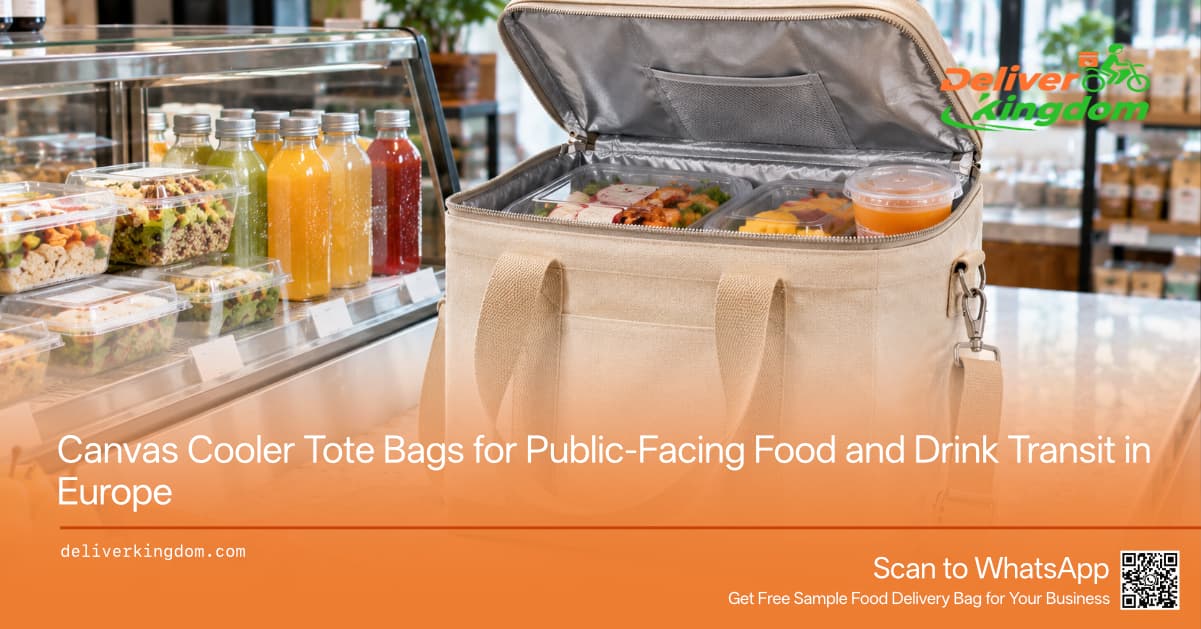
A hospitality runner leaves a café kitchen with bottled drinks, wrapped sandwiches, and a slim cold pack, then walks into a hotel lobby or an office reception where the bag will sit on a counter in front of the guest. In that setting a thick courier backpack or a boxy platform delivery bag reads as equipment. The drop is meant to look like a simple hand-carry: a quiet, structured canvas tote with a long shoulder strap, not a rider pack unzipped at a building entrance. An unlined canvas tote has the right silhouette, but bottles sweat, cold packs wet the base, and street air moves straight into an open mouth. The commercial problem is a conflict of appearance and function. European café groups, specialty food shops, office catering teams, and hotel or restaurant programs that hand-carry chilled food over short urban distances need a bag that still looks like a minimal tote on the sidewalk and still gives the food and drinks a closed, insulated cavity for the walk. That walk is often a few streets on foot, or a short hop from a tram or metro exit into a lobby, after which the tote sits closed on a reception desk while the order is checked. DeliverKingdom manufactures insulated and thermal food bags, grocery-related carriers, and related commercial transport bags from a Guangzhou headquarters and a Yangchun, Guangdong plant operating since 2013, with roughly 12,000 square meters of production space and more than 400 staff. For buyers briefing a custom cooler tote, the useful questions start with how the bag is seen in public, what it has to carry, and which shell, base, strap, zipper, and lining choices can support that walk without turning the tote into a courier pack.
When a Tote Silhouette Fits Better Than a Backpack or Box-Style Bag
A tote hangs from one shoulder or is lifted by short handles, sits on a café counter or reception desk, and presents a soft rectangle rather than a technical pack. That silhouette suits staff who walk into offices, hotel corridors, or shop floors where the bag is part of the service, not a back-of-house tool, including drops that end at a reception desk after a walk through a pedestrian street. Capacity is the first limit. A single tote can hold a modest set of bottles, sandwich packs, pastry boxes, or a small catering tray; it is a poor match for stacked multi-order meal boxes or a long bicycle route that needs both hands and a higher load. A delivery backpack spreads weight across both shoulders, frees the hands on a bike or scooter, and usually looks like workwear even when the fabric is quiet. A box-style delivery bag stands in a car trunk or on a kitchen floor, accepts a deeper stack, and still reads as equipment when it is carried through a lobby. The tote is the right tool when the route is mainly walking, the load is a short drop rather than a peak courier wave, and visual calm matters as much as volume. It is the wrong tool when the same staff must carry a heavy mixed stack for a long stretch, ride in weather with the bag on the back, or keep many orders upright in one cavity. Choosing the silhouette first prevents a cooler tote brief from inheriting backpack hardware that would spoil the look, or from promising a volume the tote shape cannot honestly hold.
Heavyweight Beige Canvas as a Public-Facing Outer Shell
Heavyweight beige canvas is specified because it looks like a grocery or lifestyle tote rather than a coated nylon courier shell. The beige, lightly marked face sits more quietly in a hotel lobby or on a specialty-food counter than black, diamond-texture delivery fabric. The same color and fiber have limits. Untreated or lightly finished canvas wets out in rain and at the base where bottles and cold packs leave moisture; beige shows coffee splash, sauce, and street dirt more clearly than a dark technical fabric. A heavier canvas holds shape better at the walls and takes abrasion at the corners more patiently than a fashion-weight cloth, but it still scuffs, fuzzes, and darkens at the base where the tote is set down on pavement. Coated nylon or polyester courier shells shed rain and wipe cleaner; they also look like delivery equipment, which is exactly the appearance many public-facing programs are trying to avoid. Some commercial canvas totes add a water-resistant finish or a coated underside at the base to slow soak-through, at the cost of a slightly less natural hand and a face that can crack or whiten if the coating is too stiff. Beige canvas is a visual and tactile choice with a cleaning and weather budget, not a weatherproof delivery shell that happens to be tan. Programs that walk mostly under cover can live with a textile face; programs that stand in rain at curbside will see the canvas age faster than a coated courier bag.
Structured Bodies and Reinforced Bases That Keep a Tote Standing
An ordinary soft tote collapses when bottles and food boxes sit in the center, so the silhouette sags, the base rounds, and containers lean into each other. A structured cooler tote keeps a standing rectangular body by putting firmness into the walls and a board or layered pad into the base. Side panels may hide a thin board, a dense foam sheet, or a stitched panel that resists folding; the base is usually built up with an extra fabric layer plus a removable or sewn-in board so the bag can be set on a kitchen floor or a wet sidewalk without immediately collapsing. Each approach has a cost. A stiff board holds a crisp tote shape and a flatter floor for bottles, but it creases if the empty bag is folded for freight, and a hard edge can wear the outer canvas at the perimeter. Foam alone is kinder in a carton and more comfortable against the hip, yet it slumps under a dense bottle load and may not recover a sharp base after a wet day. Removable boards let a depot pack bags flatter and replace a warped insert; they can shift if the sleeve is loose. The canvas face is rarely the only place to inspect. Fold creases can form in a base board, the four base corners can fray or shine from being set down, and walls can slump if they are folded repeatedly and then asked to stand open again. Buyers who want a tote that stands open on a packing counter should expect less compact shipping; buyers who need flat inbound freight should accept a slightly softer standing shape or plan for boards that go in after unpacking.
Long Shoulder Straps and the Load They Put on One Shoulder
A long shoulder strap lets a staff member keep both hands free on a crosswalk, a stair, or a building entry while the tote hangs at the hip. That convenience concentrates the whole load on one shoulder and lets the bag swing. A loosely packed bottle load will rock with each step; a bag that hangs too low bumps the thigh and twists the mouth. Strap width and padding change how that load feels, but they do not remove the one-shoulder limit: a tote remains a one-sided carry. Attach points at the upper corners or on a webbing loop take repeated pull from walking and from setting the bag down. The junctions, and the bar-tacks or boxed stitches that hold them, are wear points worth checking, especially when the tote is lifted by the strap with a full bottle load. Short grab handles, if specified with the long strap, are for lifting the tote onto a counter or carrying a heavy load with both hands for a short distance. A long strap alone is awkward for a precise counter set-down; short handles alone force a hand-carry through the street. Many commercial programs therefore want both, with the long strap long enough to wear on the shoulder over a coat, and the handles short enough that they do not dangle into the zipper. The brief should state how far the bag is typically walked and whether staff wear it on one shoulder or also lift it by handles, rather than asking only for a long strap and discovering the hang length on the first sample.
How a Full-Length Zipper Changes a Tote in Transit
An open-top canvas tote is easy to pack and easy to reach into, and it also leaves food, drinks, and cold packs exposed to street air and to view. A full-length zipper closes the mouth for the walk, keeps loose items from pitching out when the bag swings, and hides the contents on a reception desk. Full-length usually means the zipper runs the long top edge and, on many structured totes, drops a short way down each side so the mouth can open wide enough for a tray or a row of bottles. A zipper that stops short at the corners is simpler at the side panels, but it forces a narrower opening and can scuff tall containers during packing. A very long zipper on a soft mouth can gape if the top edge has no structure; a structured rim or a firm piping helps the zipper close in a straight line. The zipper is a closure, not a cooler latch. It reduces how much air and rain reach the cavity when it is fully shut, and it does not turn the soft bag into a watertight vessel. Condensation and meltwater can still collect at the base and can still find needle holes and zipper tape. Access is the other trade: staff must unzip to reach a single bottle, which is slower than an open tote and cleaner than leaving the mouth open for the whole walk. Programs that pack and unpack once per drop usually accept that step; programs that reach into the bag all morning may find a full zipper more friction than they wanted.
Thermal Insulation and Silver Linings in a Soft Cooler Tote
Thermal insulation in a soft cooler tote is typically a layer of foam between the canvas shell and an inner face. The foam slows heat moving through the walls, but the result depends on thickness, how completely the foam fills the panel, whether it is compressed in use, and how much air still moves at the zipper and seams—not on density as a stand-alone measure. A thicker build can add some resistance and also makes the tote bulkier, harder to fold, and slightly less like a slim canvas bag. A silver-toned or foil-faced lining mainly gives the cavity a smooth, often wipeable face around bottles and cold packs. Any reflective effect is only one part of that construction and should not be treated as a stand-alone cold-holding feature. Condensation still beads on a silver-toned lining and can run to the base, where it may sit against the board and the lower canvas if the bag is left closed after a drop. The construction is still a soft tote. It does not have the rigid lid, latch, and thick wall mass of a hard cooler, and the zipper line and flexing sides remain paths for air. Foam and lining help a pre-chilled load on a short urban walk, especially when a cold pack travels in the cavity, but hold time should be checked with a sample and the real contents, not judged from the lining’s appearance. If a hot dish will share the tote with chilled drinks, the same foam and lining cannot keep two temperatures apart the way separate bags can; that mix belongs in the brief before lining and cavity layout are fixed.
What Belongs in a Small Internal Pocket
A small internal pocket is not a second food well. It is a shallow sleeve or zip pouch on an inner wall, usually near the mouth, for items that should not rattle among bottles and food boxes. Typical contents are a delivery note, a folded allergen card, spare cutlery sleeves, a bottle opener, or a slim ice pack if the pocket is sized and placed for that purpose. Many small pockets are too short or too narrow for a standard cold pack; in that case the pack belongs in the main cavity, against the lining and beside the food, and the pocket should be reserved for dry documents and utensils. Placement matters as much as size. A pocket low on the wall sits in the condensation zone and wets paper; a pocket that covers a large share of one wall steals bottle width and can prevent a tray from sitting flat. An open-top sleeve is faster to reach and spills more easily when the tote is tilted; a zippered pocket holds a note more securely and adds another zipper pull inside an already tight mouth. The pocket should not be asked to carry sauces or dripping packs that belong in the main well or in a separate wipeable sleeve. When the brief simply asks for a small internal pocket, samples often arrive with a token pouch that does not fit the ice pack or the document the team actually carries. Listing the one or two items that must live in the pocket, and saying whether a cold pack will sit there or in the main cavity, keeps the pocket useful instead of decorative.
Branding, Beige Color, and Freight Packing for Commercial Programs
Logo work on heavyweight beige canvas behaves differently from print on a dark coated courier bag. Screen or transfer prints sit on a textured, often slightly irregular weave; fine type and large solid blocks can look broken or overly stiff on a natural canvas face. Embroidery and woven patches read well on a tote front, and they add thickness where the bag flexes at the upper panel. Placement should clear the shoulder strap path and the area that rubs against a coat, or the mark will wear before the rest of the shell. Beige itself is not a single, perfectly repeatable color. Undyed or lightly dyed canvas can shift from lot to lot, look warmer or greyer in different light, and darken with use and moisture at the base and handles. Programs that need a tight color match across reorders should approve a fabric standard and a strike-off rather than describing beige only in words. Structured totes with sewn-in boards also fight compact freight: a standing body that works on a café counter takes more carton volume than a soft unlined tote, and deep folds across a board leave the crease described earlier. Removable base boards and moderately flexible wall inserts pack flatter and add an assembly step at the destination. Commercial programs usually choose one priority—ready shape on arrival, or denser inbound packing—and live with the other side of that trade, rather than expecting a rigid standing tote to travel like a fold-flat promotional bag.
What Commercial Buyers Should Send DeliverKingdom for a Cooler-Tote Sample
A cooler-tote sample moves faster when the brief describes the walk and the contents, not only a list of features. DeliverKingdom supports OEM and ODM programs for insulated and thermal food bags, grocery-related carriers, and related commercial transport bags from the Guangzhou and Yangchun manufacturing base noted above. Useful inputs include confirmation that the silhouette is a structured tote rather than a backpack or box bag; typical contents, such as bottles, sandwich packs, pastry boxes, or small trays, and whether any hot item will share the cavity; whether ice packs are used on every run and whether they sit in the main well or in a pocket; preference for a long shoulder strap, short handles, or both, and how the bag is usually worn; zipper length and whether the mouth must open for a tray; canvas color and weight direction, including any water-resistant finish at the shell or base; the small pocket’s actual contents; and logo artwork with size and placement on the beige face. With those notes DeliverKingdom can propose shell, board, strap, zipper, lining, and pocket details, then build a sample to walk with real food and drinks. Commercial teams ready for a prototype can contact DeliverKingdom through deliverkingdom.com with that usage brief and artwork so the first tote reflects a public-facing European drop rather than a generic insulated shopper.
Q: When is a canvas cooler tote a better choice than a delivery backpack or a box-style bag?
A: A tote suits walking routes and public-facing handoffs where the bag will sit on a counter and should look like a quiet canvas carrier. Capacity is limited to a modest set of bottles, food packs, or a small tray. A backpack is the better carry for bike or scooter work and heavier loads; a box-style bag stands in a trunk and still reads as equipment in a lobby. Choose the tote when visual calm and short pedestrian drops matter more than volume.
Q: Does a silver lining keep food and drinks cold for a set number of hours?
A: Foam in the walls can slow heat moving through the panels; how well it does so depends on thickness, coverage, compression, and gaps at the zipper, not on foam density alone. A silver-toned or foil-faced lining is mainly a smooth, often wipeable inner face, not a stand-alone guarantee of cold hold. A soft tote still flexes at the sides and closes with a zipper rather than a rigid lid, so warming depends on ice-pack use, how full the bag is, how often it is opened, and the weather. Walk a sample with the real contents rather than judging hold time from the lining’s appearance.
Q: What is the tradeoff between a structured standing body and flatter freight packing?
A: Sewn-in boards and firm wall inserts help a tote stand on a packing counter and give bottles a flatter floor, but they crease if the empty bag is folded tightly and take more carton volume. Removable boards and softer foam pack flatter and can slump under a dense bottle load or shift in a loose sleeve. Programs usually pick ready shape on arrival or denser inbound packing, then accept the other side of that trade.
Q: Should a cold pack go in the small internal pocket or in the main cavity?
A: Only if the pocket is sized and placed for a slim pack, and even then the pocket sits better high on the wall, away from condensation at the base. Many small pockets are too short or too narrow for a standard pack. In that case the pack belongs in the main cavity against the lining, and the pocket should hold dry notes, cards, or utensils.
Q: What should buyers send DeliverKingdom to request a custom cooler-tote sample?
A: Share that the bag is a structured tote, typical contents, any hot-and-cold mix, ice-pack use and placement, strap and handle preference, zipper and mouth opening needs, canvas color and finish direction, what the small pocket must hold, and logo artwork with placement on the beige face. Commercial terms such as quantity and timing are confirmed with DeliverKingdom sales for the specific program.

 Dapatkan Penawaran Online