
Guangzhou A.C.T Products Co.,Ltd To Make The Global Delivery More Efficient
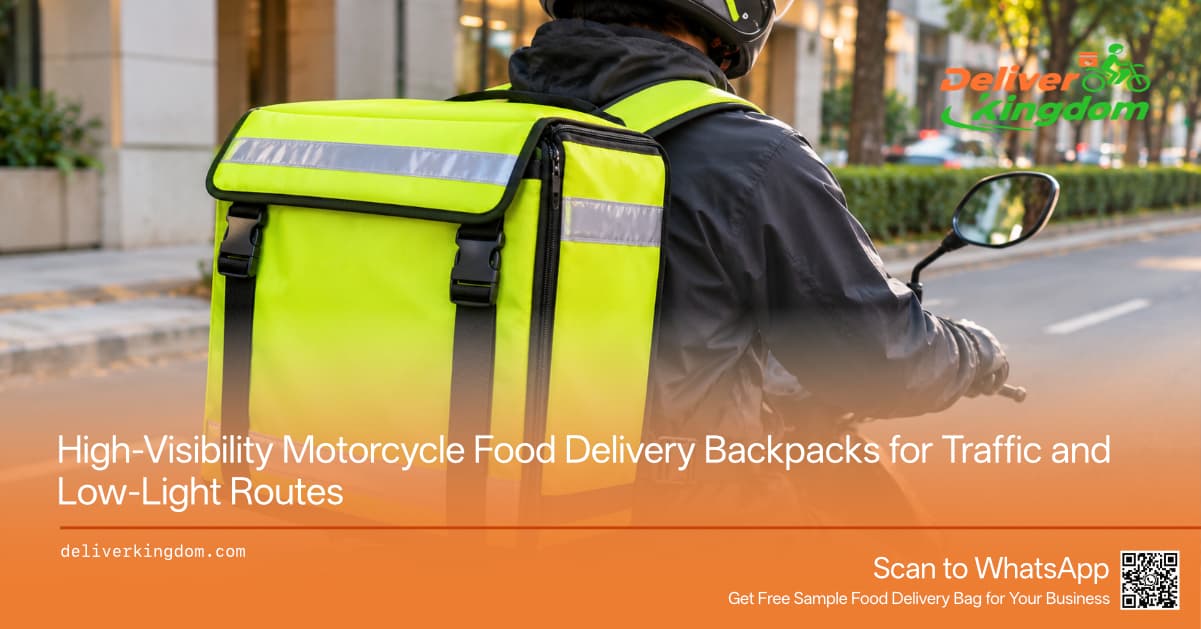
A motorcycle or moped courier works in mixed urban light: hard sun at midday, long shadows at dusk, headlights after dark, and rain that flattens contrast on wet pavement. The largest surface facing following traffic is often not a rack box or a vest edge. It is the back of the pack on the rider. A rear-mounted delivery box stays on the vehicle and keeps its face to the street even when the rider walks a doorway. A backpack moves with the body, and different road users see different faces of that pack. Following vehicles see the back panel, the upper lid or top, and only the rear portions of the shoulder straps where they leave the pack and pass over the shoulders. Traffic at an intersection sees a side panel and the outer edge of a strap. Oncoming traffic, or a viewer ahead at a crossing, sees the chest-facing lengths of the shoulder straps; those front lengths are not in view from a vehicle behind the rider. That is why a motorcycle food delivery backpack built for commercial routes has to do more than carry insulated meals. It has to remain visible from the directions that actually matter on the route, stay on the rider through braking and corners, and still open cleanly at the door. DeliverKingdom, established in 2013, manufactures insulated and thermal food bags, rider delivery equipment, and related commercial transport bags from a Guangzhou headquarters and a production plant in Yangchun, Guangdong, with roughly 12,000 square meters of production space and more than 400 staff. For fleet programs that specify a high-visibility backpack, the useful questions start with how the pack is seen from the rear, the side, and the front, how fluorescent fabric and reflective tape share those surfaces, and how the harness and the food compartment are built to work together.
Fluorescent yellow, lime, and orange outer shells are meant to be conspicuous in daylight and at dusk, when there is still ambient light for the dye to work with. Retroreflective tape does a different job. It returns light from headlights and street lamps toward the source, which is what makes a pack readable after dark. A bright shell with no tape can recede once the light drops. Tape on a dark or dirty shell can show up in a headlight beam and still be easy to miss in late afternoon shade. High-visibility work on a delivery backpack is therefore a pairing of shell color and tape, not a choice of one or the other. The useful limit is just as practical. Fluorescence dulls when the face is filmed with road grime or faded by sun and washing, and tape only returns light that actually reaches it, so a strip hidden in a fold, under a flap, or behind a hanging rain cover does not do the work a flat photograph suggests. Color and tape should be specified together, with a clear idea of which surfaces stay visible while the rider is moving and which are covered by a flap, a cover, or the rider’s arms.
On a backpack, the surfaces that face traffic are not limited to the flat back panel, and they are not all visible from the same direction. Following vehicles see the back panel, the upper lid or top, and the rear lengths of the shoulder straps where those straps leave the pack and crest the shoulders. They do not have a direct view of the chest-facing strap lengths. Traffic at an intersection sees a side panel and the outer edge of the near strap. A viewer ahead of the rider sees the front lengths of the shoulder straps, and perhaps a sternum strap, which is why tape on the chest-facing straps is specified for frontal visibility, not as a mark for vehicles behind the rider. A layout that puts a single strip across the back and leaves the sides and the relevant strap lengths bare has a blind side from one of those directions, even if the back panel looks well marked on a studio table. Hardware competes for the same faces. Zipper tracks, top flaps, carry handles, and buckle paths interrupt a continuous band. Tape also has to turn around the curved edge of a padded strap, where a width that looks generous on a flat panel can narrow, wrinkle, or stop short of the buckle. Tape width belongs in the specification rather than being decided after the shell is cut, and a program that wants coverage on the back, the sides, and the strap lengths that face a given direction should say so in the layout. The tradeoff is coverage against flex and access. Too little tape leaves dark gaps from one viewing angle. Too much tape across a zipper, a handle base, or a tightly curved strap can interfere with opening, stitching, or the way the harness bends on the rider.
A motorcycle delivery backpack keeps meals in an insulated compartment that the rider carries on the body, not in a rigid box locked to a tail rack. That changes the engineering. Insulation thickness that is easy to accept on a vehicle-mounted box becomes weight and bulk on the shoulders, and every added millimeter of foam reduces the usable inner volume for a given outer size. Soft walls also do not hold a stack of trays the way a hard-sided box does. Orders shift when the rider leans or brakes, unless the interior has a shelf, a divider, or a packing method that matches the food being carried. The opening path matters as much as the volume. A top opening can be simple to load at the restaurant and awkward at a doorway if the rider has to tilt the pack or take it off. A front or clamshell opening can present the food more directly, but it puts a longer zipper on a face that may also carry tape, a flap, and a handle. None of these choices should be sold as a universal best layout. The right compartment is the one that holds the usual order size without overloading the rider, opens with a predictable motion at the door, and leaves enough structure for the outer color and tape to stay visible while the pack is worn.
Motorcycle and moped routes throw water at a pack from above and from the road. A coated woven polyester or a coated PVC or tarpaulin face can shed rain across the panel, and that is usually what buyers mean when they ask for a waterproof or water-resistant exterior. The limit sits at the openings. A zipper is a stitched, toothed line; a rain flap over the zipper helps, but it is not the same as a sealed seam, and water can still enter around the slider, at the zipper ends, or along unsealed stitch holes if the pack is ridden in heavy spray. Fully taped or welded seams on a coated shell can tighten the face against leakage and also change how the pack folds, how it is repaired, and how stiff it feels on the back. A looser water-resistant fabric may pack smaller and flex more comfortably, then wet through sooner at the seams. The honest specification names the outer material, whether seams are taped, and how the zipper is protected, rather than treating “waterproof” as a finished performance claim. What the pack must survive is wet riding between stops, plus the wipe-down that follows, not an unspecified laboratory rating.
Food delivery leaves a predictable mess: sauce and oil inside, condensation on a cool or warm lining, and a film of street dirt on the outside. An easy-clean interior usually means a wipeable lining, commonly a smooth coated or foil-faced surface that can be wiped after a shift rather than laundered like apparel. The exterior of a high-visibility pack has a second cleaning problem. Fluorescent yellow, lime, and orange show dirt readily, and a dull, stained shell is less conspicuous in daylight even if the tape is still in place. Road film and food marks also sit at the edges of reflective strips, where residue is harder to wipe without lifting the tape. Coatings that wipe clean can feel stiffer or more plastic than an uncoated weave, and aggressive cleaners can haze a fluorescent face or weaken tape adhesion if they are not compatible with the finish. The tradeoff is a shell that stays bright enough to do its daylight job and a lining that can be wiped without soaking the insulation behind it. Buyers should say how the pack will be cleaned in daily use, because a construction that only looks clean in a new sample may not survive a season of sauce, rain, and roadside wiping.
A backpack built for motorcycle or moped work needs a harness that keeps the load stable when the rider brakes, corners, or catches wind, and that still comes off or shifts enough to open the pack at a doorway. Shoulder straps alone are often not enough. Under hard braking, the pack’s inertia can cause it to slide up the rider’s back toward the shoulders and neck if the load is hanging only from the shoulder straps; a waist belt anchors the pack at the hips and resists that upward shift. A sternum strap is a different part: it connects the two shoulder straps across the upper chest so those straps are less likely to slip outward off the shoulders, but it does not replace a waist belt as the lower anchor. In a turn, the pack can still shift sideways if that hip anchor is loose or unused. Many commercial rider packs are therefore specified as a harness—shoulder straps, a sternum strap, and a waist belt—rather than as a pair of simple straps. The opposite pressure is speed of access. Riders dismount and remount all day. A harness that is very secure can be slow to release, and a quick-release setup that is convenient at the door can loosen on the bike if the adjusters creep or the waist belt is left undone. Padding helps over a long shift and also adds heat and thickness under a jacket. The harness is a load-carrying system for a food pack, not a substitute for rider protective clothing, and it should be judged on strap placement, adjustability, and how it behaves with a typical load, not on claims the construction has not been shown to support. The sample is the place to check whether the pack stays centered on a rider and still opens in a normal stop.
Some fleet programs want a high-visibility pack with no factory identity on it: no logo, no brand patch, no hanging tag, and no trademark on the hardware. Unbranded supply is more than leaving a print area blank. Factory marks can appear as a woven label at the lining or strap, a rubber or woven patch on the back or lid, a branded zipper pull, a heat-transfer mark, a hangtag, or a sticker left on in packing. Any one of those can put a name on a pack that was supposed to arrive clean. The request should list the surfaces and trims that must stay clear, including the interior label area if that also has to be unmarked. A completely clean shell also has a limit. Buyers who later apply their own fleet mark need a face that was planned for that mark, not a back panel already crossed by tape, a handle, and a leftover factory label. Buyers who want no mark at all still sometimes need a discreet way to identify a production lot for quality follow-up; that method should be agreed so it does not read as a brand on the street-facing surface. Unbranded is a marking policy, not a different bag category, and it has to be written into the order the same way color and tape layout are written in.
A photograph of a lime or orange pack cannot confirm how tape wraps a padded strap, whether a zipper flap covers a reflective band, or how the harness sits on a rider with a loaded compartment. A printed or sewn sample on the real outer material and the intended tape can show those clashes. A flat fabric swatch and a short length of tape are useful for color and hand, and they will not show the three-dimensional problems: tape narrowing at a strap curve, a rain cover hiding the back panel, or a waist belt that sits under a jacket. A complete sewn backpack costs more and takes longer than a swatch, but it is the piece that can be worn, loaded, wiped, and viewed from the rear and the side. Programs that require documentation for fluorescent fabric or retroreflective tape should ask for what can be provided against the actual materials, not assume that a high-visibility color is already covered by a clothing or material certificate. Applying reflective tape or a fluorescent shell to a backpack does not, by itself, make the finished pack a certified piece of protective or high-visibility apparel. Material documents and a finished-pack certification are separate questions, and they should be stated in the inquiry so the quotation and the sample match what the program actually needs to review.
A workable inquiry for a high-visibility motorcycle food delivery backpack describes the route and the pack together. It should state the order quantity, the preferred outer dimensions or capacity, the estimated loaded weight the rider will carry, and the destination, because those figures affect quotation, packing, and freight. It should also state the outer color among the usual fluorescent options or a specified shade, where tape must run on the back, the sides, the top, and the strap lengths that face the rear, the side, or the front, and any minimum tape width the program requires. It should describe the insulated compartment in terms of the usual order, the preferred opening path, and whether a shelf or divider is needed, along with the harness arrangement the riders will actually use—shoulder straps only, or a sternum strap and a waist belt as well. Water resistance should be named as a material and zipper treatment, not as a bare adjective. If the pack must arrive unbranded, the inquiry should say which labels, pulls, tags, and packing marks have to stay off the goods. If the program needs supporting documents for the fluorescent fabric or the tape, that request should be included so it can be checked against the materials under discussion. Those material documents are not a substitute for asking, separately, whether a finished-pack certification is required. DeliverKingdom works as an OEM and ODM manufacturer on commercial food delivery packs and rider equipment, and a quotation is firmer when those points arrive together. Sample cost, production timing, and packing details are confirmed with the sales team against the agreed construction, rather than taken from a generic list.
Q: What should be included in an inquiry for a bulk order of high-visibility motorcycle food delivery backpacks?
A: The useful details include the order quantity, the preferred dimensions or capacity, the estimated loaded weight, and the destination, together with the fluorescent outer color, the tape layout and any required tape width on the body and on the strap lengths that face the rear, the side, or the front, the harness arrangement, how the insulated compartment should open and hold orders, the expected rain protection, and whether the pack must be supplied unbranded. Packing notes can be added so the sales team can quote the actual build rather than a generic backpack.
Q: Can the outer shell be made in fluorescent yellow, lime, or orange with reflective tape on the pack and the shoulder straps?
A: Those fluorescent colors and tape placements are a normal specification for a high-visibility delivery backpack. The layout still has to be planned around zippers, flaps, handles, and the curved strap edges, and the materials should be confirmed for the actual shell rather than assumed from a color name alone.
Q: Can the backpacks be supplied fully unbranded, with no factory logos, tags, or trademarks?
A: Yes, unbranded supply can be specified, but it should list every place a factory mark might otherwise appear, including woven labels, patches, zipper pulls, hangtags, and packing stickers. If a discreet production mark is still needed for quality follow-up, that can be agreed so it does not show as a brand on the street-facing face.
Q: Is a fabric and tape swatch enough, or is a complete sewn backpack needed as the sample?
A: A swatch is enough to review color, hand, and the look of the tape on a flat piece of shell. A complete sewn backpack is the piece that shows tape on the strap curves, zipper and flap clearance, harness fit, and how the pack looks from the rear and the side when it is worn. Which sample is produced, and on what schedule and terms, is confirmed with sales for the construction under discussion.
Q: How should water resistance, insulation, and the rider harness be described in an inquiry?
A: Name the outer material and zipper protection, how the insulated compartment should open and what it needs to hold, and whether the harness includes a sternum strap or waist belt in addition to the shoulder straps. DeliverKingdom can then work from that use description, and capacity, foam thickness, and timing are confirmed on the agreed build.

 Dapatkan Penawaran Online